

 Australian Dollar($)
 Danish Krone (kr)
 Euro (€)
 Japanese Yen (¥)
 Norwegian Kroner (Kr)
 Swedish Krona (kr)
 Great British Pound (£)
 US Dollar ($)
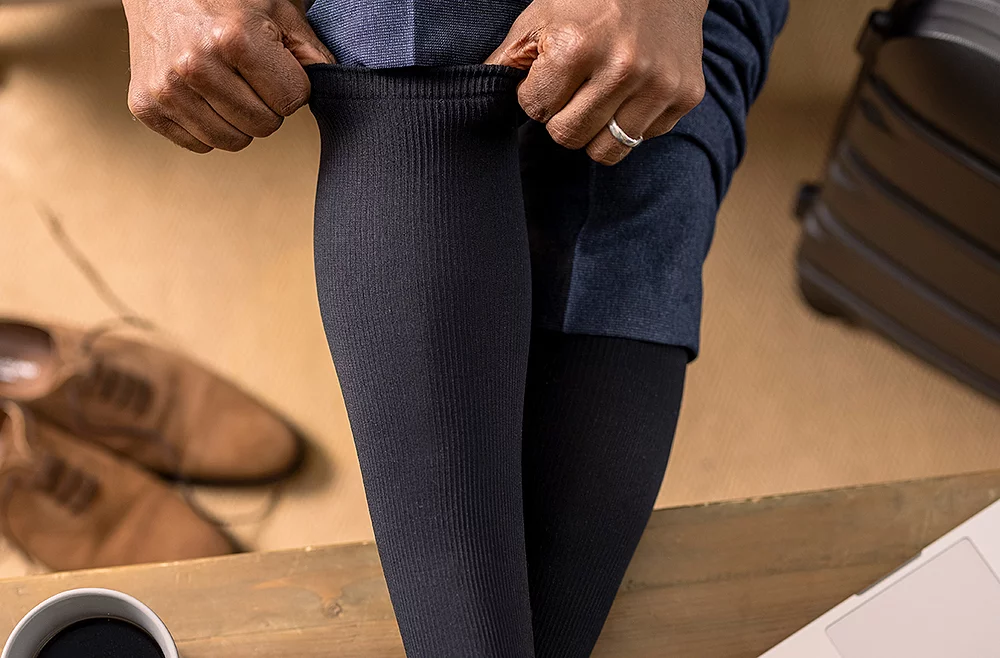
Compression socks come up a lot in conversations about restless legs, and there is a fair amount of confident advice online about them. Some of it overstates things. This guide sets out what restless legs actually is, what the research does and does not show about compression, and how to wear compression socks properly if you decide to try them.
One thing to say up front. We sell socks. We are not doctors, and restless legs can have underlying causes worth investigating. If your symptoms are disrupting your sleep, speak to your GP. There is a specific reason for that, and we will come back to it.
What restless legs syndrome actually is
Restless legs syndrome, sometimes called Willis-Ekbom disease, is a condition of the nervous system. It causes an overwhelming urge to move the legs, usually alongside an uncomfortable sensation that people describe in different ways: crawling, tingling, aching, fizzing, or simply an itch you cannot scratch.
The pattern is fairly consistent:
- It comes on when you are resting or sitting still
- It gets worse in the evening and at night
- Moving your legs relieves it, at least temporarily
- It comes back when you stop moving
What causes it
- Pregnancy, particularly in the later stages
- Chronic kidney disease
- Peripheral neuropathy
- Certain medications
- Poor circulation in the legs, including venous insufficiency
So do compression socks help?
The honest answer is that the evidence is limited, but it is not nothing.
The most useful study is a randomised controlled trial published in 2024, which looked at 63 pregnant women with restless legs. One group wore compression stockings, the other wore a placebo stocking that looked the same but applied no meaningful compression. Both groups improved, which tells you something about how much of this is expectation. But the compression group improved more, with a bigger reduction in symptom severity.
There is also research showing a strong overlap between restless legs and venous problems. A 2021 study found that a large majority of people with venous disease also had restless legs symptoms. That does not prove one causes the other, but it does suggest that for some people, poor circulation in the legs is part of the picture. If that is true for you, compression is doing something useful about the underlying problem rather than just masking a symptom.
What we would not say is that compression socks treat restless legs, or that they work for everyone. The trial above was small and looked at one specific group. Anyone telling you compression socks are a cure is selling you something.
What is reasonable to say is this. If your restless legs are connected to circulation, compression may help. It is low risk, it is inexpensive compared with most things you could try, and if it does not work for you after a few weeks you have lost very little.
When to wear them, and this bit is important
Here is where a lot of advice online gets it wrong.
Because restless legs is worse at night, people assume you should wear compression socks in bed. In the 2024 trial, the women put their stockings on in the morning and took them off at bedtime. The NHS also advises against wearing compression stockings in bed unless a healthcare professional has specifically told you to.
The reasoning makes sense once you think about it. Compression works by helping blood move back up the leg against gravity while you are upright. Lying down, gravity is no longer working against you, so the compression is not doing the job it was designed for. Wearing tight garments overnight without medical advice is not a good idea.
So the practical approach is:
- Put them on first thing in the morning, before any swelling builds up
- Wear them through the day, particularly if you sit or stand for long periods
- Take them off at bedtime
The idea is to arrive at the evening with your legs in better shape, rather than trying to fix them once you are already in bed.
What compression level do I need?
Compression is measured in millimetres of mercury, written mmHg. The higher the number, the firmer the squeeze.
Light compression, roughly 8 to 15 mmHg. Gentle support for tired legs and mild swelling. A sensible place to start if you have never worn compression before.
Mild to moderate, roughly 15 to 20 mmHg. The most common everyday level. Suits most people looking for support through a long day of sitting or standing.
Firm, 20 to 30 mmHg and above. This is medical territory. If you are considering this level, particularly for a diagnosed condition, talk to your GP or pharmacist first.
For restless legs, most people are best starting at the lighter end and seeing how they get on. Graduated compression, where the pressure is firmest at the ankle and eases as it goes up the leg, is the type you want. That gradient is what encourages blood back towards the heart.
Fit matters as much as the number. A compression sock that is too tight at the top will dig in and restrict rather than help, and one that is too loose does nothing at all. Measure your calf and check the size guide rather than guessing from your shoe size.
What else is worth trying
Compression is one option among several, and it is worth being straightforward that the NHS suggests a number of things before anyone mentions socks:
- Get your iron levels checked. This is the big one. Ask your GP about a ferritin test.
- Look at your evening routine. Caffeine, alcohol and nicotine in the evening can make symptoms worse.
- Move before bed. Walking, stretching or massaging your legs can settle symptoms when they come on.
- Try warmth. A warm bath or a heat pad on the legs before bed helps some people.
- Improve your sleep environment. Dark, quiet, cool. Restless legs and poor sleep feed each other.
- Check your medications. Some can worsen symptoms. Your GP can review them.
If your symptoms are severe, there are prescribed treatments available. That conversation belongs with your doctor, not a sock shop.
Choosing your socks
If you want to give compression a go, a few practical points.
Look for graduated compression rather than a sock that is simply tight all over. Check the mmHg rating is stated, because if a brand will not tell you the compression level, it probably is not offering meaningful compression.
Think about material. Bamboo and cotton-rich options are more breathable if you are wearing them all day, and softer against the skin if your legs are already irritable. If you have diabetes or any loss of sensation in your feet, be careful, and speak to a healthcare professional before wearing anything compressive.
Our range of compression socks covers everyday support levels through to sports compression, in cotton, bamboo and technical fabrics. If you are on your feet all day, or sat still for most of it, our flight socks are built for the same problem.
The short version
Restless legs is a real neurological condition, not just fidgeting. It is often linked to low iron, which is worth getting tested, and sometimes to poor circulation in the legs.
Compression socks may help, particularly where circulation is part of the problem. The evidence is encouraging but limited. Wear them through the day and take them off at night, start at a lighter compression level, and get the fit right.
And if it is keeping you awake, go and see your GP. A ferritin test costs you nothing and could tell you more than any pair of socks.
This article is for general information and is not medical advice. If you have symptoms that concern you, or you have a diagnosed condition such as diabetes, venous disease or neuropathy, speak to your GP, pharmacist or another healthcare professional before wearing compression garments.














Get involved and tell us what you think. Comments may be subject to moderation.