

 Australian Dollar($)
 Danish Krone (kr)
 Euro (€)
 Japanese Yen (¥)
 Norwegian Kroner (Kr)
 Swedish Krona (kr)
 Great British Pound (£)
 US Dollar ($)
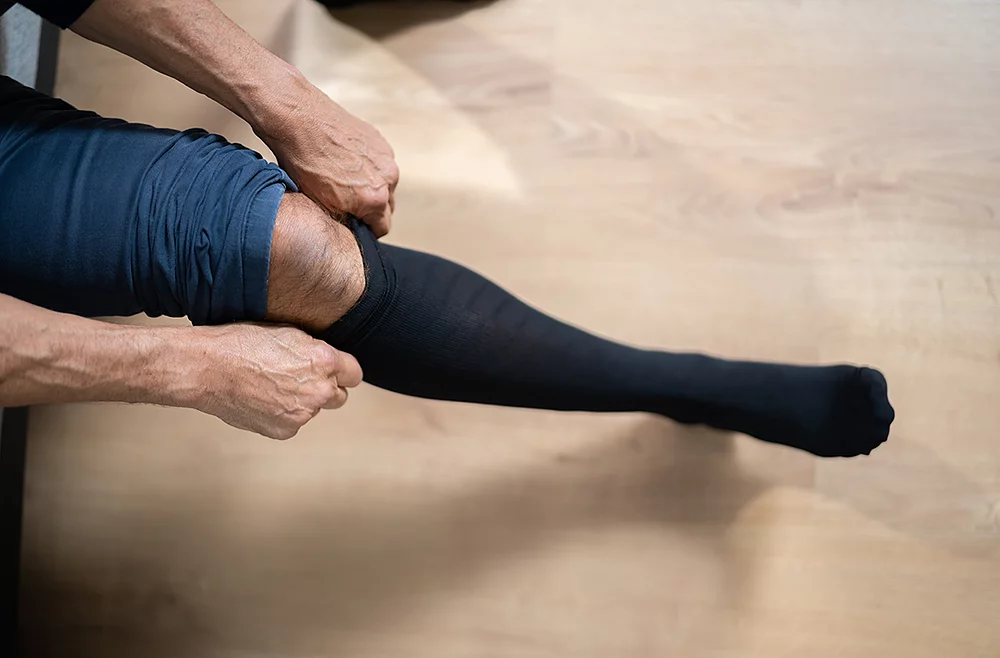
What a compression sock actually is
A compression sock squeezes your leg. That is the short version.
The important part is how it squeezes. A proper compression sock uses graduated compression, meaning the pressure is firmest at the ankle and gradually eases as it goes up the calf. That gradient is doing a job. It gives blood a gentle push in the direction you want it to go, back up towards the heart.
A sock that is simply tight all over is not a compression sock. It is a tight sock, and it will not do the same thing. If anything, even pressure can make matters slightly worse by squeezing the leg without encouraging blood anywhere.
Why your legs need the help in the first place
Blood gets to your feet easily. Gravity does most of the work. Getting it back up again is the harder job.
The muscles in your calf do most of that work. Every step you take, they squeeze the deep veins in your leg and push blood upwards. It is often called the calf muscle pump, and you never notice it because it just happens.
The problem comes when you stop moving. Sit at a desk for six hours, stand behind a counter all day, or spend eight hours in an aeroplane seat, and the pump stops. Blood pools in the lower leg. Your ankles swell, your legs feel heavy and tired, and over time that pooling can contribute to more serious problems.
Compression socks do the calf pump's job for it while you are not moving.
What mmHg means
Compression is measured in millimetres of mercury, written mmHg. It is a pressure measurement, borrowed from blood pressure. The higher the number, the firmer the squeeze.
8 to 15 mmHg. Light. Gentle support for tired, aching legs and mild swelling. A sensible place to start if you have never worn compression before, and enough for most people who just want their legs to feel better at the end of the day.
15 to 20 mmHg. Mild to moderate. The most common everyday level, and the one used in most flight socks. Suits long periods of sitting or standing, travel, and pregnancy. Still available without a prescription.
20 to 30 mmHg and above. Firm. This is medical territory. Used for varicose veins, lymphoedema, after a DVT, and other diagnosed conditions. If you are considering this level, speak to your GP or pharmacist rather than guessing. Too much compression, or the wrong fit, can cause problems.
If a brand will not tell you the mmHg rating, be sceptical. It probably is not offering meaningful compression.
Who actually benefits
There is decent evidence behind compression for some things, weak evidence for others, and none at all for a few of the claims you will see.
Good evidence: long flights. A Cochrane review of 12 trials and nearly 3,000 passengers found compression stockings substantially reduce symptomless deep vein thrombosis on flights over four hours.
Good evidence: swelling and tired legs from standing or sitting all day. This is the everyday use, and it is the one most people buy for.
Reasonable evidence: pregnancy, particularly for swelling and for restless legs in the later stages.
Mixed evidence: sport. Compression does not appear to improve running performance, though there is some evidence it helps with recovery afterwards.
And they are not for everyone. If you have diabetes, peripheral neuropathy, peripheral arterial disease, or any loss of sensation in your feet, speak to a healthcare professional before wearing anything compressive. Compression can be actively unhelpful in some circumstances, and it is worth checking rather than assuming.
Getting the fit right
This matters as much as the compression level, and it is where most people go wrong.
Measure your calf at its widest point, and your ankle at its narrowest. Use those against the size guide. Do not go off your shoe size, because your shoe size tells you nothing about the shape of your calf.
A sock that is too tight at the top will dig in, leave a mark, and restrict blood flow rather than help it. A sock that is too loose will do nothing at all. Either way you have wasted your money.
And put them on properly. They should be smooth against the leg, with no bunching or rolled-over cuffs. A rolled cuff creates a tight band, which is the exact opposite of graduated compression.
How to wear them
- Put them on in the morning, before your legs have had a chance to swell. They are much easier to get on at that point, and they work better.
- Wear them through the day, particularly if you are sitting or standing for long periods.
- Take them off at night. Compression works by helping blood up the leg against gravity. Lying down, gravity is not the problem, so there is no benefit, and wearing tight garments overnight without medical advice is not advisable.
- Wash them properly. Compression comes from elastane, and elastane degrades. Most compression socks need replacing every three to six months with regular wear.
Do you actually need a pair?
Honest answer: probably not, unless something on this list applies to you.
- You are flying for more than four hours
- You sit or stand still for most of your working day
- Your legs and ankles ache or swell by the evening
- You are pregnant
- You have varicose veins, or a history of blood clots
- You have been told to wear them by a healthcare professional
If none of that applies and your legs feel fine, you do not need compression socks. Plenty of people wear them anyway because their legs feel better at the end of the day, and that is a perfectly good reason. But it is comfort, not necessity, and nobody should be telling you otherwise.
Our range of compression socks covers everyday light support through to firmer graduated compression, in cotton, bamboo and technical fabrics. If you are specifically looking for travel, our flight socks are the place to start.
FAQs
Are compression socks and flight socks the same thing?
Broadly yes. Flight socks are compression socks marketed for travel, usually at a light to moderate compression level. The sock itself is doing the same job.
Can I wear compression socks every day?
Yes, at everyday compression levels. Put them on in the morning and take them off at night. If you are wearing firmer medical-grade compression, follow whatever advice you were given.
Do compression socks help varicose veins?
They can help with the symptoms, particularly aching and swelling. They will not make varicose veins go away. If you have them, it is worth a conversation with your GP about the right compression level.
Can compression socks be harmful?
For most people, no. But if you have diabetes, poor arterial circulation, or reduced sensation in your feet, compression can cause problems and you should get advice first. Ill-fitting compression can also do more harm than good.
How long do compression socks last?
With regular wear, usually three to six months. The compression comes from elastane, and elastane loses its stretch. Once they go on easily, they have probably stopped working.
This article is for general information and is not medical advice. If you have a diagnosed condition such as diabetes, venous disease, arterial disease or neuropathy, or you are concerned about your circulation, speak to your GP or pharmacist before wearing compression garments.














Get involved and tell us what you think. Comments may be subject to moderation.