

 Australian Dollar($)
 Danish Krone (kr)
 Euro (€)
 Japanese Yen (¥)
 Norwegian Kroner (Kr)
 Swedish Krona (kr)
 Great British Pound (£)
 US Dollar ($)
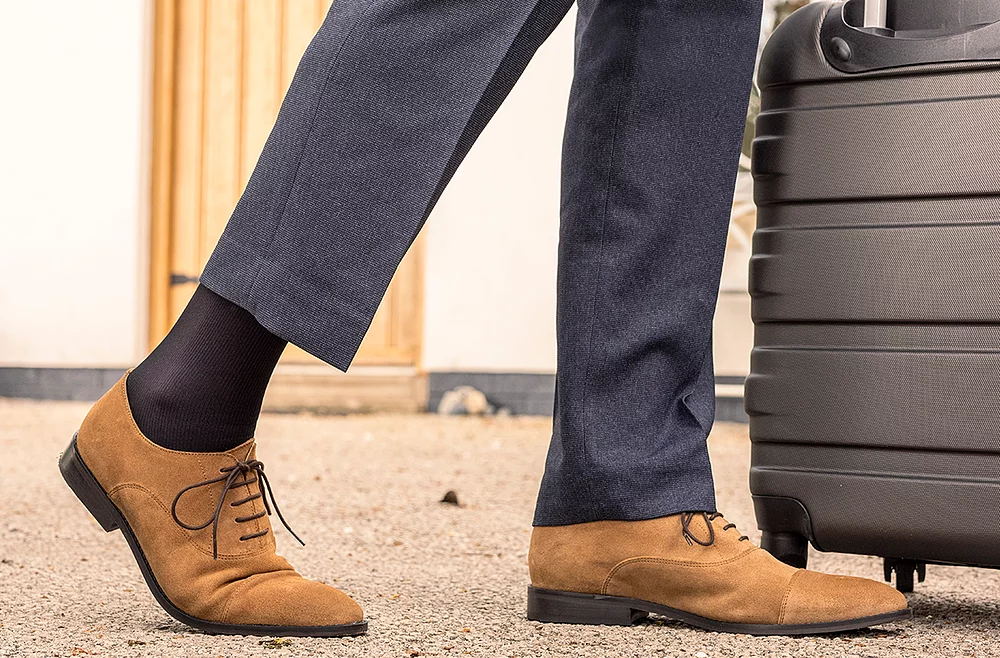
Most things sold to travellers are optional at best. Flight socks are one of the few that have proper evidence behind them, and it is worth understanding what that evidence actually says, because it is more specific than most people realise.
What flight socks actually are
Why sitting still on a plane is a problem
When you walk, the muscles in your calf squeeze the deep veins in your leg every time you take a step. That squeezing is what pushes blood back up towards the heart against gravity. It is often called the calf muscle pump, and it does a lot of quiet work.
Sit still for hours and the pump stops. Blood pools in the lower leg. Your ankles swell, your legs feel heavy, and in a small number of people the pooled blood can form a clot. That is a deep vein thrombosis, or DVT.
Flight socks are doing the calf pump's job for it while you sit there.
So do they work? Here is what the evidence says
This is where it gets interesting, because flight socks have been studied properly.
The Cochrane Collaboration, which reviews medical evidence and is about as independent as it gets, pooled 12 randomised trials covering nearly 3,000 airline passengers on flights of four hours or more.
What they found: high-certainty evidence that wearing compression stockings substantially reduces symptomless DVT. The odds came down by roughly 90%. In plain terms, the rate dropped from a few tens per thousand passengers to around two or three per thousand.
They also found moderate-certainty evidence that superficial vein thrombosis is reduced, and lower-certainty evidence that leg swelling is reduced. No significant side effects were reported in any of the trials.
That is a genuinely strong result, and stronger than the evidence behind most things sold to travellers.
But here is the bit nobody mentions
The word doing a lot of work in that finding is "symptomless".
Across all 12 trials and nearly 3,000 passengers, there were no deaths, no pulmonary embolisms and no symptomatic DVTs at all. Not one. Which means the research simply cannot tell us whether flight socks prevent the serious, dangerous outcomes people are actually worried about. The events are too rare to measure without an enormous study that nobody has done.
So the honest position is this. Flight socks clearly reduce the clots that get detected on a scan but that you would never have known about. Whether that translates into preventing the clots that make you seriously ill is unproven, not disproven. It is a reasonable assumption, but it is an assumption.
Anyone telling you flight socks will stop you dying on a plane is overselling it. Anyone telling you they do nothing is ignoring good evidence.
Who should actually wear them
The American Society of Haematology takes a fairly restrained line: they do not recommend compression socks for low-risk travellers on short flights, and recommend them on longer flights mainly for people at higher risk of clots.
That seems sensible to us. The threshold that matters is the one used in the research: flights of four hours or more.
Worth wearing if you are on a long flight and any of these apply:
- You have had a DVT or blood clot before
- You are pregnant, or recently gave birth
- You have had surgery recently
- You are over 60
- You are taking the contraceptive pill or HRT
- You have a clotting disorder, cancer, or a heart condition
- You have limited mobility, or a leg in a cast
- You are significantly overweight
If none of those apply and you are on a two-hour hop to Dublin, you probably do not need them. Plenty of people wear them anyway simply because they arrive with less swollen ankles, and that is a perfectly good reason, but it is comfort rather than risk.
What compression strength do I need?
For flying, you are generally looking at light to moderate compression.
Light, roughly 8 to 15 mmHg. Gentle support. Reduces swelling and heaviness. Fine for most healthy travellers.
Moderate, roughly 15 to 20 mmHg. The level most flight socks sit at, and the one used in most of the research. A sensible default for a long-haul flight.
Firm, 20 to 30 mmHg and above. Medical territory. If you have had a clot before, or you have a diagnosed condition, talk to your GP or pharmacist about the right level rather than guessing.
Fit matters as much as the number. A sock that digs in at the top can restrict rather than help, and one that is loose does nothing at all. Measure your calf and use the size guide. Do not go off your shoe size.
How to wear them
- Put them on before you leave for the airport, not once you are in your seat. Swelling starts before you take off, and they are far easier to get on before your legs puff up.
- Wear them for the whole flight, including any connections.
- Take them off once you are settled at the other end. There is no need to sleep in them.
- Make sure they are smooth. A rolled or bunched cuff creates a tight band, which is the opposite of what you want.
What else helps
Compression is one part of it. The research also points at the obvious:
- Get up and walk about. Every couple of hours if you can. This is the single most effective thing and it is free.
- Flex your ankles in your seat. Point your toes, then pull them back towards you. That works the calf pump without leaving your row.
- Drink water. Cabin air is dry and dehydration thickens the blood.
- Go easy on the alcohol. It dehydrates you and it makes you less likely to get up and move.
If you are at genuinely high risk, this is a conversation for your GP before you fly, not a decision to make in the departure lounge.
Choosing your socks
Check the mmHg rating is stated. If a brand will not tell you the compression level, it probably is not offering meaningful compression, and you are just buying a tight sock.
Look for graduated compression specifically, rather than a sock that is simply firm all over.
Think about material if it is a long flight. Cotton-rich and bamboo options are more breathable and softer against the skin than pure synthetics, which matters over twelve hours.
And if you have diabetes, neuropathy, or any loss of sensation in your feet, speak to a healthcare professional before wearing anything compressive.
Our flight socks range covers everyday travel support in a range of sizes and materials. If you want something for standing or sitting all day rather than just flying, our wider compression socks range goes from light everyday support up to firmer graduated compression.
The short version
Flight socks work by doing the job your calf muscles would be doing if you were not sat still. There is good evidence they reduce silent clots and swelling on flights over four hours, and no evidence of harm.
Whether they prevent the serious clots is unproven, because those are too rare to have shown up in the research. They are cheap, they are low risk, and if you are in any of the higher-risk groups they are an easy decision.
And walk about. That bit is free.
This article is for general information and is not medical advice. If you have had a blood clot before, are pregnant, have a diagnosed condition, or are concerned about your risk of DVT, speak to your GP or pharmacist before flying.














Get involved and tell us what you think. Comments may be subject to moderation.